We often think about fitness in terms of strength, endurance, or appearance. But there is another important part of physical health that often gets overlooked: mobility.
Mobility is not simply about being flexible. It is your body’s ability to move freely, efficiently, and comfortably through the range of motion required for everyday activities.
From bending down to tie your shoes to turning your neck, climbing stairs, exercising, or simply getting out of a chair, good mobility plays a role in almost everything you do.
What Is Mobility?
Mobility refers to how well your joints and surrounding muscles allow you to move.
While flexibility describes how much a muscle can lengthen, mobility combines joint movement, muscle flexibility, strength, coordination, and control.
For example, being able to touch your toes does not necessarily mean you have good overall lower-body mobility. Your body needs to control movement as well as achieve a certain range of motion.
Why Does Mobility Matter?
1. It Makes Everyday Movement Easier
Simple activities such as walking, squatting, reaching, bending, and climbing stairs require adequate mobility.
When your movement is restricted, everyday tasks can become uncomfortable or require your body to compensate in other ways.
2. It Can Support Better Posture
Limited mobility in areas such as the hips, thoracic spine, or shoulders can influence how you sit, stand, and move.
Improving mobility can help your body move into more comfortable and efficient positions.
3. It Supports Exercise and Performance
Whether you enjoy running, strength training, yoga, or recreational sports, your body needs sufficient mobility to perform movements effectively.
Good mobility allows you to move through appropriate ranges of motion while maintaining control.
4. It Helps You Stay Active as You Age
Movement naturally becomes more challenging when we spend less time being physically active.
Maintaining mobility throughout life can make it easier to continue performing everyday activities and participating in the activities you enjoy.
5. It Helps Your Body Move More Efficiently
When one area of the body has limited movement, another area may compensate.
For example, restricted ankle or hip movement can change how you perform a squat or walk.
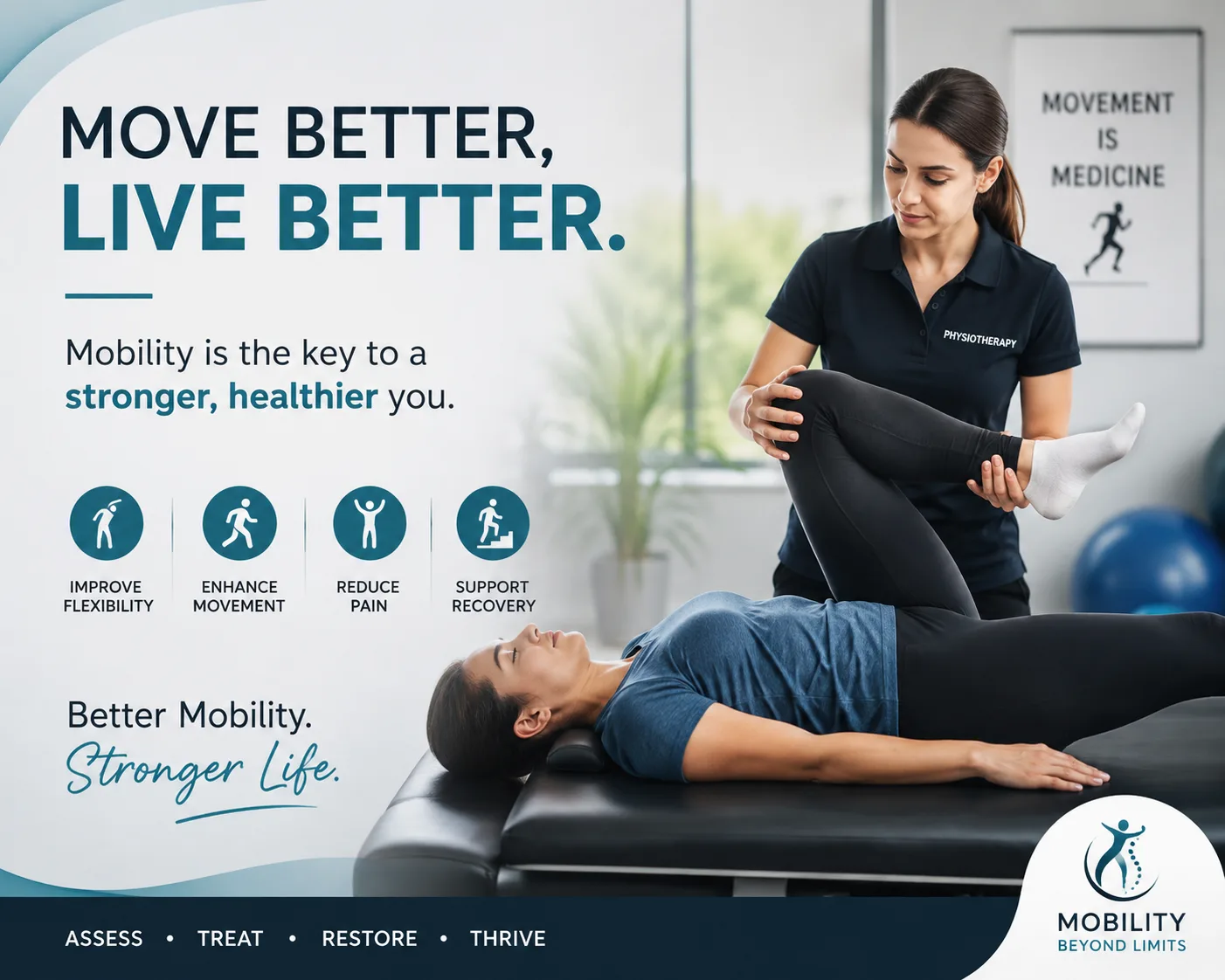
A physiotherapy assessment can help identify movement limitations and determine whether targeted mobility, strengthening, or movement exercises may be appropriate.
Signs You May Have Limited Mobility
Mobility limitations can sometimes be subtle. You may notice:
- Difficulty squatting comfortably
- Stiffness after sitting for long periods
- Reduced shoulder movement
- Difficulty turning your neck
- Tight or restricted hips
- Difficulty reaching overhead
- Reduced ease of movement during exercise
- Feeling stiff when getting out of bed or after prolonged inactivity
These signs do not necessarily mean you have an injury, but persistent or worsening symptoms are worth discussing with a qualified healthcare professional.
Mobility Is More Than Stretching
One common misconception is that improving mobility simply means stretching more.
Stretching can be useful, but mobility is broader than flexibility.
Effective movement may require a combination of:
Mobility + Strength + Stability + Coordination + Movement Control
That is why a personalised approach can be more useful than simply performing random stretches.
How Can You Improve Your Mobility?
Small, consistent habits can make a difference.
Move regularly: Avoid staying in one position for extended periods.
Work on your range of motion: Controlled mobility exercises can help you explore comfortable movement.
Build strength: Strong muscles help you control your available range of motion.
Improve movement quality: Focus on controlled, purposeful movements rather than simply moving farther.
Stay consistent: Mobility generally improves through regular practice rather than occasional intense sessions.
If you experience persistent pain, significant stiffness, or difficulty performing normal activities, professional assessment can help identify the underlying movement limitations.
The Bottom Line
Mobility is not just about touching your toes or performing impressive stretches.
It is about being able to move with confidence, control, and comfort.
Your body is designed to move. The goal is not necessarily to achieve extreme flexibility—it is to develop the mobility, strength, and control you need for the life you want to live.
Move better. Feel better. Live better.
At Muscle Mechanic, the focus is on understanding how your body moves and helping you work toward better movement through appropriate assessment and personalised physiotherapy care.